
Lee County Release Records Explained
A Lee County Jail release is an event recorded by the sheriff. It means the jail stopped holding a person on that booking. It does not always mean the person went home. The person might have posted bond, completed a sentence, received credit for time served, or left under a dismissal or other court order. The person might instead have moved to TDCJ, another county jail, federal custody, immigration custody, a hospital, or another agency.
The next source depends on that event. The Lee County Sheriff's Office holds its own booking and release records. A court record explains the order, judgment, sentence, or case result behind a release. TDCJ maintains state-prison information. The Board of Pardons and Paroles and Parole Division handle state parole processes, while a local community-supervision department handles probation. A transfer must be traced to the receiving agency before it is described as return to the community.
Lee County Inmate Release Types
The recorded authority matters more than a simple released label. Lee County's unavailable online module prevented confirmation of the exact labels used in its public entries. The terms below are common concepts to seek in an agency record, not a claim about the sheriff site's displayed fields.
| Release path | What it means | Next record source |
|---|---|---|
| Bond or personal bond | The person left jail while the case remains pending. | Sheriff release record and the court's bond order |
| Time served or sentence completion | The custodial term credited to that case ended. | Release timestamp, judgment, and sentence record |
| Dismissal or court order | A court action supplied release authority. | Signed order plus sheriff processing record |
| Parole or mandatory supervision | A state prisoner leaves confinement under TDCJ supervision. | TDCJ records and Parole Division |
| Transfer or detainer pickup | One custodian released the person to another. | Receiving jail, TDCJ, BOP, ICE, or USMS |
Does bond mean the case ended? No. Bond permits departure while the case continues. The court docket and later judgment or dismissal show what happened in court, while the sheriff record shows when jail processing ended.
Note: A release timestamp proves the Lee County booking ended, but an identified transfer shows that custody continued elsewhere.
Fields in Lee County Release Records
A focused request should identify the exact booking and seek the fields needed to distinguish freedom from transfer. Because the released module was in maintenance during research, these are request targets supported by local record creation and agency roles. They are not presented as verified web columns. Lee County corrections staff book, fingerprint, photograph, classify, transfer, and release people, which makes the sheriff the logical record custodian.
| Field | What it shows |
|---|---|
| Full name and booking number | Links the release to the correct booking. |
| Booking and release date/time | Marks the custody period recorded by Lee County. |
| Arresting and confining agency | Identifies which agency created and held the record. |
| Release type or authority | May distinguish bond, order, completed term, or transfer. |
| Receiving agency or destination | Shows continued custody when releasable and recorded. |
| Charges and bond information | Ties the event to the booking and case, subject to disclosure law. |
| Booking photograph | May help identify the booking, but disclosure is record-specific. |
No official retention term was found for either the online released view or the underlying record. The public feed and the agency file are separate things. Ask the sheriff for the historical record and applicable retention schedule instead of assuming an entry stays online for a set number of days.
Request Lee County Release Records
The sheriff provides a designated public-information channel and an open-records request form. Requests may go by mail to P.O. Box 98, Giddings, TX 78942, by fax to 979-542-1446, or by email to info@leecountysherifftx.org. The Records Division number is 979-542-2800 extension 226. The agency rejects blanket or open-ended demands and supplies only records generated by its office.
- Give the full name, known birth information, booking number, and a narrow date range.
- Ask for existing booking and release records, including date, time, type, authority, and any public transfer notation.
- Request an electronic copy and ask that confidential portions be redacted while the rest is released.
- Ask for an itemized estimate before costs exceed an amount you choose. Lee County posts no fixed local price for these records.
- Send court, TDCJ, laboratory, or other records to the agency that created them.
Texas requires prompt production, but no fixed Lee County completion time was found. If records cannot be produced within ten business days, the governmental body must give a certified reasonable availability date. That rule is not a universal promise of delivery within ten days. The official page also warns that an electronic request sent somewhere other than the designated address may not trigger a response.
The sheriff's request page shows the available submission channels. Its captured view confirms where a narrow Lee County release-record request belongs.
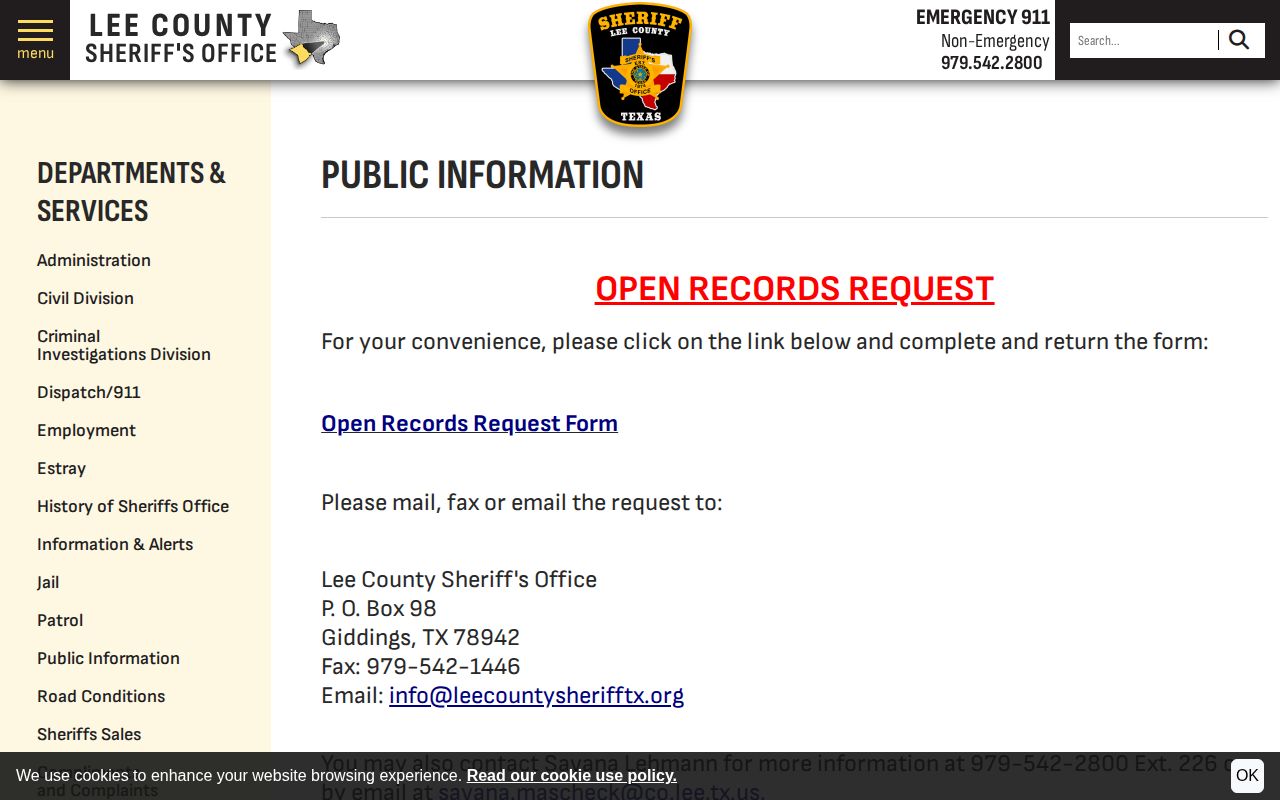
Use the designated general email when an individual contact address appears inconsistent, and keep a copy of the request.
Texas Law on Lee County Releases
Texas Government Code Chapter 552 governs public information. Section 552.021 states the access principle. Section 552.221 covers prompt production, and Sections 552.261 and following address allowable charges. Law-enforcement exceptions, active cases, privacy rules, juvenile confidentiality, court sealing, and expunction can limit what an agency releases. A custodian may redact protected parts or seek an Attorney General decision when required.
A booking photograph is not automatically public or automatically confidential in every Texas case. Lee County creates it during booking, but the sheriff must apply the law to the requested record. The release module's outage also prevented confirmation that photographs appear with released entries. Asking for releasable portions avoids an all-or-nothing request.
Note: The online feed's unknown retention does not set the retention period for the sheriff's underlying Lee County release records.
Can Lee County Release Records Disappear?
Texas expunction law moved to Code of Criminal Procedure Chapter 55A after the 2025 recodification. Release, dismissal, or acquittal by itself is not an expunction order. Eligibility depends on the result, offense, charging history, waiting period, and other facts. Relief requires the proper court process, and the order's terms determine which records and agencies it reaches.
An order of nondisclosure under Government Code Chapter 411 is different. It limits public disclosure of qualifying history but does not mean that every record was destroyed. A missing result can also reflect sealing, juvenile confidentiality, feed retention, maintenance, or a search mismatch. The absence alone cannot reveal why the record is unavailable.
Search Lee County Released Inmates
Start with the system that last held the person. Lee County bookings begin with the sheriff. State-prison commitments use TDCJ while the person remains confined, then its inquiry and parole channels for past custody. Federal cases use BOP or the federal court. An immigration pickup must be checked through ICE. Each source answers only for its own custody.
- Open the sheriff's released filter, which is ordered by release time but has no verified 24-hour or 72-hour window.
- Use the current filter only to see whom Lee County presently reports in custody. Do not treat absence as proof.
- When the module is down, call 979-542-2800 and ask whether the person remains held or moved to another custodian.
- Request the booking and release file when a timestamp, authority, or transfer destination is needed.
- Match the case to the District Clerk, County Clerk, or justice court and obtain the order or judgment.
- Follow any transfer to TDCJ, another jail, BOP, ICE, or USMS.
The sheriff homepage visibly separates “Inmate Booking” from “Inmate Release.” That structure supports a released-first search rather than reliance on the current roster.

The two modules answer different questions, and both showed maintenance messages on the research date.
Lee County Release Filter Limits
Lee County has a true sheriff released filter, not merely a current jail roster. Its URL orders results by release time. Yet the module was in maintenance on August 2, 2026. No entries or detail pages could be checked. The exact displayed fields, refresh cycle, archive depth, photos, and retention remain unverified.
No separate same-day or three-day selector was found. Therefore, the release filter must not be called a fixed-window list. The Jail Releases: 24 Hours page explains how to check a one-day period without claiming the official feed supplies that window. When the filter returns, compare more than a name, review any detail record, and call the jail if the release type or destination is unclear.
Note: Sort order places newer Lee County release events first, but it does not establish real-time publication or a fixed time span.
TDCJ Search for Lee County Transfers
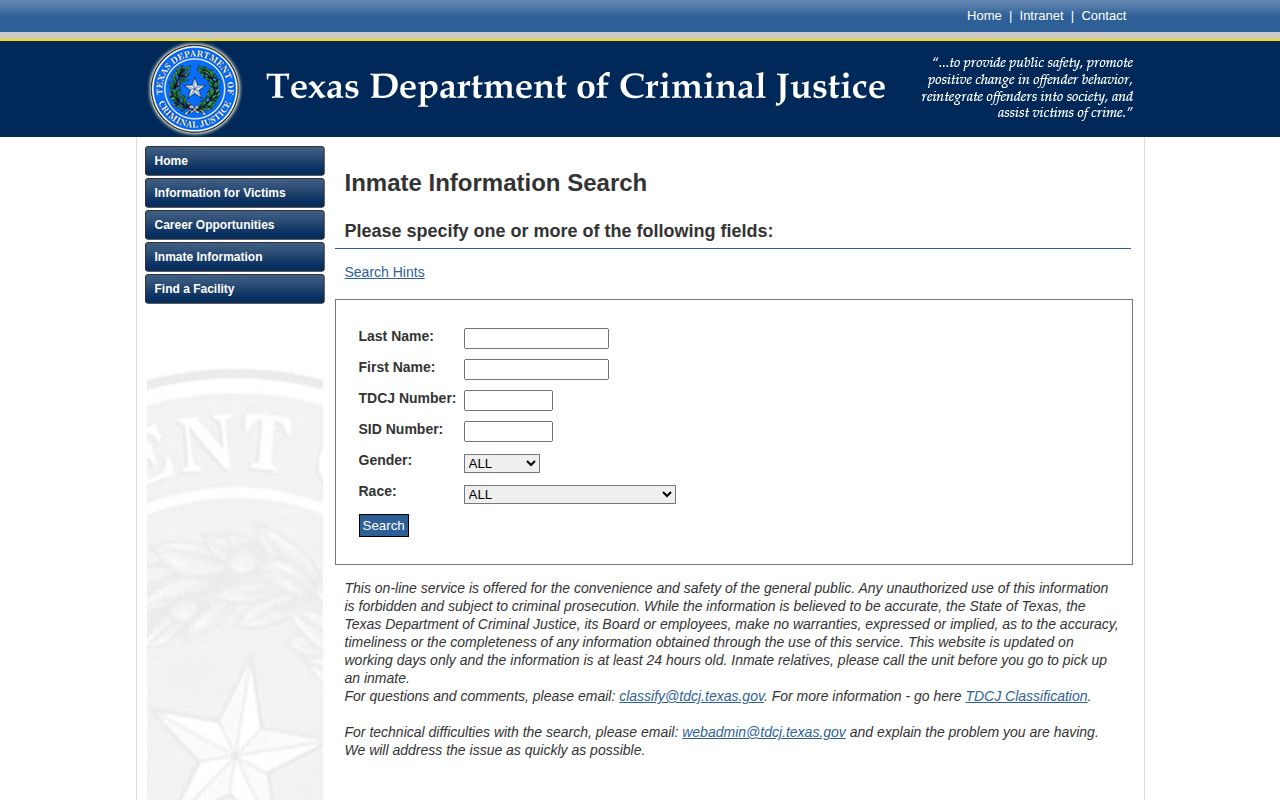
The TDCJ online offender search covers only people currently incarcerated in a TDCJ facility. It is not a historical database of released Texas prisoners. A Lee County defendant transferred after sentencing may appear while confined elsewhere in Texas. Once the person leaves TDCJ custody, a missing web result is ambiguous and must be followed through TDCJ's inquiry or records process.
| Search field | Use and limit |
|---|---|
| Last and first name | Search by identity; compare the full result carefully. |
| TDCJ number | Seven-digit state identifier, strongest when known. |
| SID number | Texas state identification number. |
| Gender and race | Optional filters that can narrow a common name. |
| Current result details | May include unit, offenses, and projected release date, not proof of departure. |
TDCJ says the search is updated on working days and is at least 24 hours old. Its no-charge email inquiry can provide available current or prior incarceration history, offense, county and court, and projected date. Supply full name and TDCJ number, or exact birth date or approximate age plus county of conviction. That email service does not provide photographs.
The official search capture shows the identity inputs and current-custody limitation.
Projected, scheduled, and actual release dates are different. A projection is conditional; scheduled fields follow approval and audit but can still change; an actual release record confirms that custody ended or transferred.
Lee County Courts Confirm Release Authority
Lee County court records explain the legal event but not the precise moment of departure. Felony cases run through the 21st and 335th Judicial District courts and the District Clerk. County-level misdemeanor records go through the County Clerk and its linked portal. Traffic and Class C matters may belong to one of three justice courts.
A docket shows scheduled activity and can change. Request the judgment, sentence, bond order, dismissal, revocation, or discharge document that answers why the custody status changed. Then use the sheriff record for the actual Lee County release time. A signed order may precede jail processing, and an order in one case does not resolve an unrelated hold.
The District Clerk page identifies the felony docket and custodian route.
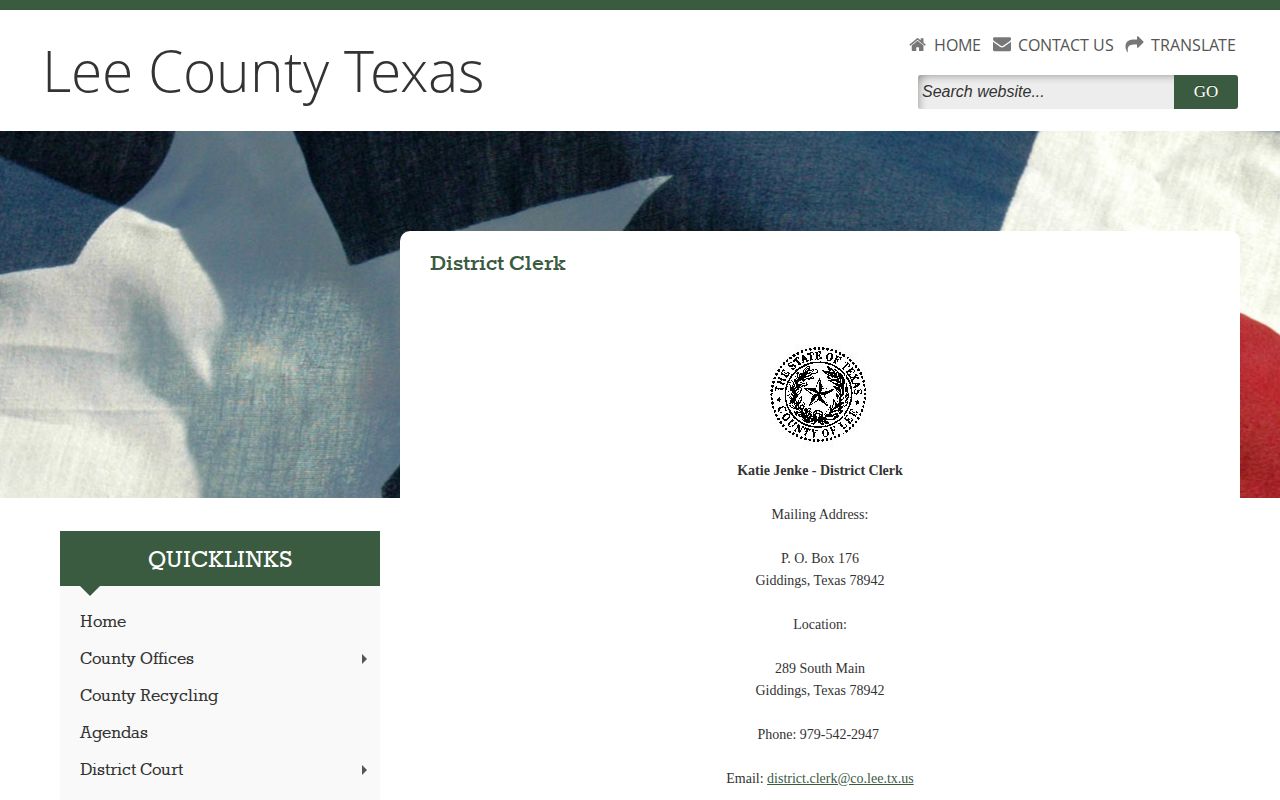
This court route complements the sheriff release record; it does not replace the jail's departure timestamp.
Correct a Lee County Registry Match
The Texas DPS registry is a narrow post-release source for people with qualifying registration duties. It can show a name, address, photo, offense, and verification agency, but it cannot establish a Lee County jail release date. It also does not cover people whose offenses do not require registration.
DPS gives a clear correction route. Report a suspected error to the verification agency named in the record. A name and birth-date match may be wrong, and DPS says only fingerprints positively establish identity. Check unmapped results as well because some reported addresses cannot be placed on the map. A registry correction goes to its named verification agency; an error in a Lee County booking record goes to the sheriff's custodian.
Lee County Release Supervision Checks
Parole, probation, discharge, and time served are not synonyms. Parole is conditional release after a TDCJ prison commitment. Mandatory supervision is a separate state-law route. Probation, also called community supervision, comes from a court and may occur without any TDCJ prison stay. Discharge means a term or supervision obligation ended as shown by the proper record.
- Parole
- Conditional release from state prison under Parole Division supervision.
- Probation
- Court-ordered community supervision administered through a local department.
- Time served
- Credit that satisfies the custodial term in the relevant case.
- Detainer
- A request or hold that may lead to transfer instead of community release.
Lee County is assigned to the Georgetown District Parole Office in Region IV, but residence and case assignment can change the actual reporting office. No public statewide name search for people living in the community on Texas parole or probation was verified. Confirm through the Parole Division, the proper district office, a focused request, and the sentencing court. More detail appears on the Probation & Parole page.
Lee County Release Alerts and Federal Records
Texas VINELink can supply an agency-fed custody status or alert when the chosen agency participates. Search one person, compare the reporting agency and identifiers, then register for the offered custody event. A released or out-of-custody alert means the source no longer reports custody. It does not rule out another jail, TDCJ, BOP, ICE, a warrant, or supervision. Confirm each alert with the source agency.
For federal imprisonment, the BOP inmate locator can show covered release records after 1982. “Released” or “Not in BOP Custody” refers only to BOP custody, while “In Transit” is not release. Federal pretrial custody may instead involve the U.S. Marshals and contract facilities. Use the federal docket, clerk, holding facility, or a focused USMS records request when no lasting BOP record answers the question.
An ICE locator result covers its own system. A no-result cannot distinguish community release, transfer, removal, recent processing, a spelling mismatch, or a data limit. A Lee County release followed by ICE pickup remains a transfer.
Where Lee County Release Status Appears
Use the source that owns the custody event. One result should never be stretched across agencies.
| System | Best use | Key limit |
|---|---|---|
| Lee County current filter | Current county-jail custody lead | Absence does not prove release |
| Lee County released filter or record | County release time, type, and transfer lead | Online window and fields are unverified |
| TDCJ search and inquiry | Current state confinement, then prior history by inquiry | Web search excludes released people |
| Court record | Order, judgment, sentence, or dismissal | Does not prove physical departure time |
| BOP locator | Covered federal custody and past release date | Does not cover all custodians |
What if every online search is blank? Recheck spelling and identifiers, then call the last known custodian. Request the release record and court disposition. Blank search results do not identify release, transfer, maintenance, confidentiality, or record aging.
Getting Home After Lee County Release
The Lee County Jail does not publish a release exit, waiting area, property-return process, or fixed release hour. Call immediately before travel because court paperwork, holds, records checks, and transfer decisions can change timing. The 24-hour nonemergency line can confirm current instructions, although staff may limit details under policy or law.
CARTS Country Bus advertises curb-to-curb Lee County service Monday through Friday from 8:00 a.m. to 4:00 p.m. Same-day or advance booking is available through the Spare app or 512-478-RIDE. Published zone fares are $2 in town, $4 within Lee County, and $6 for a multi-county day pass. A Tuesday Giddings-to-Austin trip is also listed.
CARTS does not promise pickup at the jail gate. A released person or family must confirm the pickup point, schedule, space, and fare directly. This is a possible weekday ride, not part of the sheriff's release process.
The CARTS Lee County page provides the current booking and zone details.

Confirm service close to the planned trip because the jail and transit operator manage separate schedules.
Giddings Youth Releases Are Separate
Lee County contains the Giddings State Juvenile Correctional Facility, a secure Texas Juvenile Justice Department institution. It is not Lee County Jail and not an adult TDCJ prison. The official facility directory says it was built in 1972 and occupies 195 acres with 33 buildings. Those facts describe the site, not a current population or release count.
Someone who says a person was “in Giddings” may mean this juvenile facility or the adult county jail in the same city. First identify the holding agency. Youth release, transfer, parole, or discharge follows TJJD and juvenile-court authority, with heightened confidentiality. Do not expect an adult name roster, photo list, or public release feed. The correct route is an authorized TJJD or juvenile-court channel.
Lee County Release Facilities
Lee County Jail is the adult county facility. A person may leave for the community or transfer to another custodian, so the sheriff release type and receiving agency control the next search. Giddings State Juvenile Correctional Facility is a TJJD youth institution whose confidential release process must remain separate.
No adult TDCJ unit, federal prison, or dedicated ICE detention center was verified within Lee County. Still, a Lee County case can move into any of those outside systems. Geographic location does not define who owns the next record. Follow the named agency until custody or release is confirmed.