
Lee County Release Date Meanings
TDCJ uses the exact field name Projected Release Date. Its Classification and Records Office calculates the date a current prisoner is expected to leave incarceration if parole does not occur sooner. The result is conditional. It is not an appointment, a promise, or proof of past release. Offense date, offense type, sentence, time credit, and mandatory-supervision eligibility all affect the calculation.
After favorable release action and a file audit, TDCJ may show a Scheduled Release Date and Scheduled Release Location. Those fields are more useful for planning, but TDCJ warns that a schedule can change even on the listed day. Actual release is the historical agency event. A transfer also ends one custodian's hold while custody continues elsewhere.
- Eligibility date
- The first date a case may be considered under the governing law.
- Projected release
- A conditional TDCJ calculation for a current prisoner.
- Scheduled release
- Operational information after approval and record review.
- Actual release
- The recorded event when custody ends or transfers.
Find Lee County Projected Release
Start with the custodian. The TDCJ inmate search includes only people currently incarcerated in a TDCJ facility. It accepts last name, first name, TDCJ number, SID number, gender, and race. TDCJ says its data update on working days and are at least a day old. A current detail result may show a Projected Release Date. It is not a database of released people.
A pretrial Lee County Jail detainee has no sentence-based release date. Bond, a court order, dismissal, detainer resolution, or later sentence may change custody. A county sentence may involve credit and a jail calculation, but no Lee County-specific good-time schedule or weekend rule was verified. Do not apply the TDCJ state-prison formula to the county jail.
- Identify whether the person is in Lee County Jail, TDCJ, federal custody, or another system.
- For current TDCJ custody, search by the strongest identifier and record the exact field label and date checked.
- For Lee County Jail, call 979-542-2800 and obtain the sentencing or release order from the correct court.
- After a favorable parole vote, use the official release-processing channel and ask whether scheduled fields have been set.
- Confirm the actual event with the releasing agency. Follow any transfer to the receiving custodian.
Note: A missing TDCJ result after release requires historical inquiry; it does not supply the actual discharge date.
Lee County TDCJ Search Fields
The official search is most precise with a TDCJ or SID number. Name searches need careful comparison because people can share names. The projected field belongs to the current TDCJ record and should be saved with the date checked. Do not relabel it as a fixed release date.
| Field | Use | Limit |
|---|---|---|
| Last and first name | Broad match | May return namesakes |
| TDCJ number | Seven-digit state identifier | Must match the person |
| SID number | Texas state identifier | May not be known |
| Gender and race | Narrow visible results | Not positive identity alone |
| Projected Release Date | Current conditional calculation | Can change and is not actual release |
The assigned manifest image comes from the official TDCJ search interface.
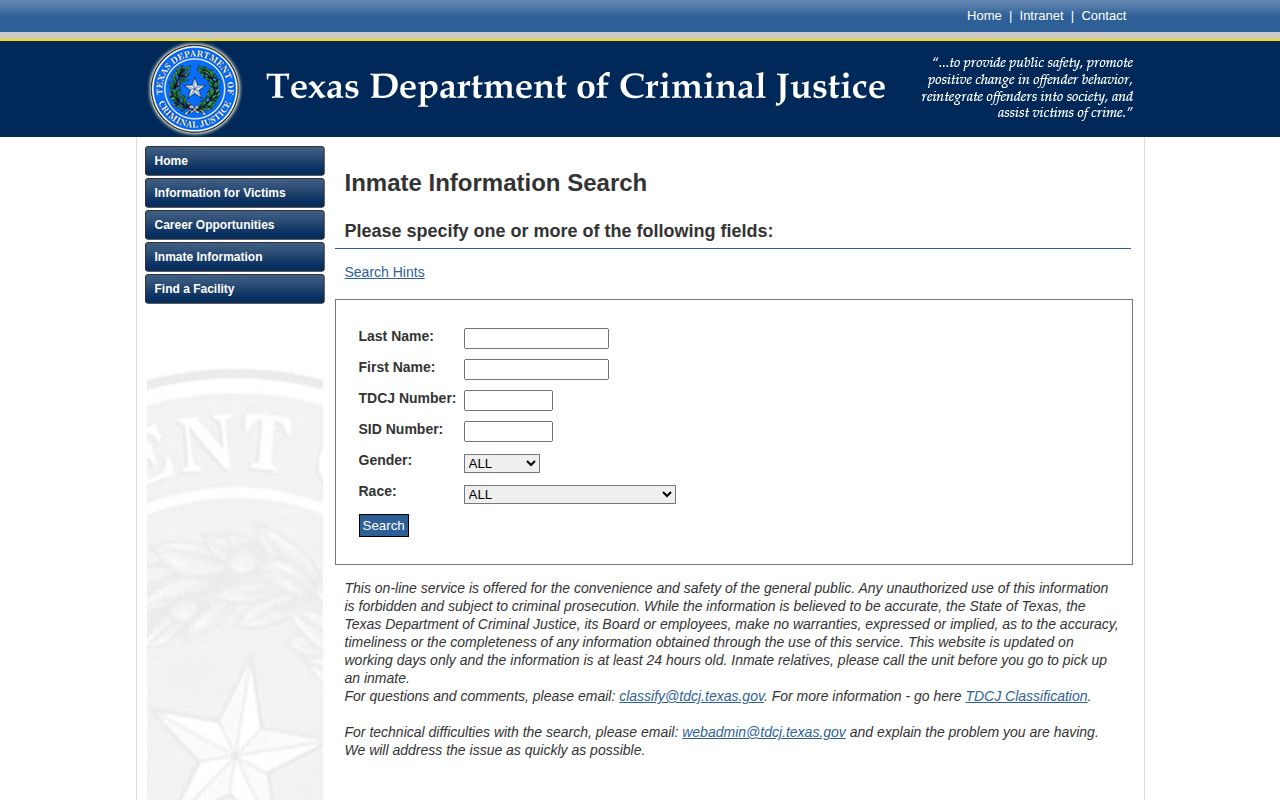
The fields help locate a current state prisoner; they do not preserve a released person's online profile.
Texas Good Time Rules
Texas Government Code Chapter 498 governs good-conduct time classification, award, forfeiture, and restoration. Good time can affect eligibility calculations and mandatory-supervision timing when the governing law permits. It is not calendar time. It does not reduce every sentence in the same way, and adding time credits never guarantees departure on a chosen date.
Government Code Chapter 508 contains several distinct rules. Section 508.145 has offense- and sentence-specific parole eligibility calculations. Section 508.147 addresses mandatory supervision, while Section 508.149 lists exclusions. Relevant facts include offense date, category, sentence, a deadly-weapon finding, prior history, and the law then in force.
Disciplinary forfeiture, a new sentence, detainer, Board vote, required program, residence approval, or records audit can shift the practical date. A detainer is another authority's request or legal basis to hold or take custody. Thus departure from TDCJ may be a transfer rather than return to the community.
No Lee County 85% Rule
Texas has no blanket law requiring every state prisoner to serve 85 percent of a sentence. That shortcut must not be used for a Lee County projected release date. Different offenses and offense dates follow different statutes. For many serious offenses linked to current Code of Criminal Procedure Article 42A.054, Section 508.145 commonly requires calendar time equal to one-half of the sentence or thirty calendar years, whichever is less, subject to statutory minimums and special categories. Good-conduct time does not reduce that calendar threshold.
Half-time eligibility is not half-time release. Eligibility only permits discretionary consideration. The Board may deny release, set a later review, require a program, or withdraw approval if new facts arise. Some other cases use different parole or mandatory-supervision rules. The judgment, offense date, deadly-weapon finding, sentence, and current statute must be read together.
A reliable calculation names the exact statute and the source date. It also separates the maximum expiration date from parole eligibility and the current TDCJ projection. A rough fraction cannot replace Classification and Records or a case-specific legal review.
Lee County Parole Has No Calendar
The Texas Board of Pardons and Paroles does not hold formal hearings for ordinary parole or mandatory-release consideration. There is no normal public Lee County parole hearing calendar to consult. Panel members review the file and vote individually. The official panel-review FAQ corrects the common assumption that every person receives a scheduled public hearing.
Administratively, Parole Division identifies a case about six months before initial eligibility and about four months before a later review. An Institutional Parole Officer develops the case summary, then a three-member panel votes in sequence. Two matching votes decide the result. A third voter resolves a split. The decision reaches the person by correspondence.
Revocation hearings are different. They concern alleged violations after supervision and have their own rights and steps. They must not be mistaken for an initial release hearing. Neither a review stage nor a favorable code is an actual release timestamp.
Lee County Dates Can Change
Every date change should be tied to a record. Common causes include time-credit changes, disciplinary action, a new judgment, an unresolved hold, denial or approval by the Board, a required program, residence review, and a final file audit. For county custody, bond changes, jail credit, court orders, warrants, and administrative processing can affect departure.
| Change | Possible effect | Confirm with |
|---|---|---|
| Good-time loss or restoration | Eligibility or projection changes where law permits | TDCJ Classification and Records |
| Board action | Later review, approval, or program condition | Board and Parole Division |
| Detainer or new sentence | Continued or transferred custody | Holding and receiving agencies |
| Residence or program approval | Scheduled release may move | Parole Division |
| County court order | Bond, sentence, credit, or release authority changes | Lee County jail and sentencing court |
For federal custody, the BOP locator may show a projected future date, and its data can change after statutory recalculation. “IN TRANSIT” is not release. A past release date or “RELEASED” concerns BOP custody only, not every possible hold.
TDCJ inquiry channels also divide by stage. The inmate locator and general information lines address current location and basic record questions. A separate Board number handles review status before an approval vote, while the Parole Division release-processing number serves cases after favorable action. Calling the wrong channel can produce an accurate answer to the wrong question. Provide the TDCJ or SID number, or the exact birth date when the office accepts it, and ask staff to repeat the label attached to any date. Record whether the answer concerns eligibility, Board action, certificate processing, a scheduled location, or actual departure.
Historical proof takes another route. TDCJ's no-charge email inquiry can return some current and prior incarceration facts when the requester supplies the published identifiers. It may include incarceration history, offense, county and court of conviction, and a projected date. That service is not a certified release document. When the precise discharge event matters, request the underlying incarceration-history or release record through the formal public-information channel and compare it with the Lee County judgment.
Confirm Lee County Actual Release
A projected date becomes useful only when paired with direct confirmation. TDCJ advises callers to contact the unit before attempting pickup. After approval, the Parole Division release-processing channel can address the status of the certificate and scheduling. The inmate locator and general information numbers serve a different stage. A processing answer remains short of proof that the person crossed the gate.
If the person has already left TDCJ and no longer appears online, the TDCJ email-information service can provide certain current and prior incarceration information when supplied with a full name and identifier or birth and conviction details. A formal public-information request may be needed for the actual release or discharge record. The broader Lee County released-inmate record path explains how to compare it with court and sheriff records.
For Lee County Jail, obtain the actual release timestamp, release type or authority, and any receiving agency. If the release was a transfer, continue the check in TDCJ, another jail, BOP, ICE, or the named custodian. Actual community return should never be inferred solely from one roster disappearing.
Write down who supplied the answer, which agency held the person, the date and time of the check, and the exact status words used. Ask whether the listed date is an eligibility date, a projection, a schedule, or a completed release. If pickup is planned, confirm the release location directly because an approved person may leave from a unit other than the place first expected. If the answer cites a hold, ask which agency owns it and use that agency's official channel next. This short audit trail prevents an old screenshot or verbal estimate from being mistaken for a final Lee County release record.