
VINELink Coverage in Lee County
VINELink’s Texas interface is the official starting point for participating sources. VINE stands for Victim Information and Notification Everyday. It receives custody events from participating agencies and lets users search a person or subscribe to offered notices. Availability must be checked in the live agency selector for Lee County and for the exact custodian involved.
The service should not be described as a universal Texas database. A missing record can result from an alias, spelling error, identifier mismatch, delayed data, agency participation, transfer, or record aging. It cannot establish release by itself. Lee County Jail’s own released filter and records channels remain the local sources for a county booking. The Texas Department of Criminal Justice maintains separate current-inmate, parole-status, and victim-notification systems.
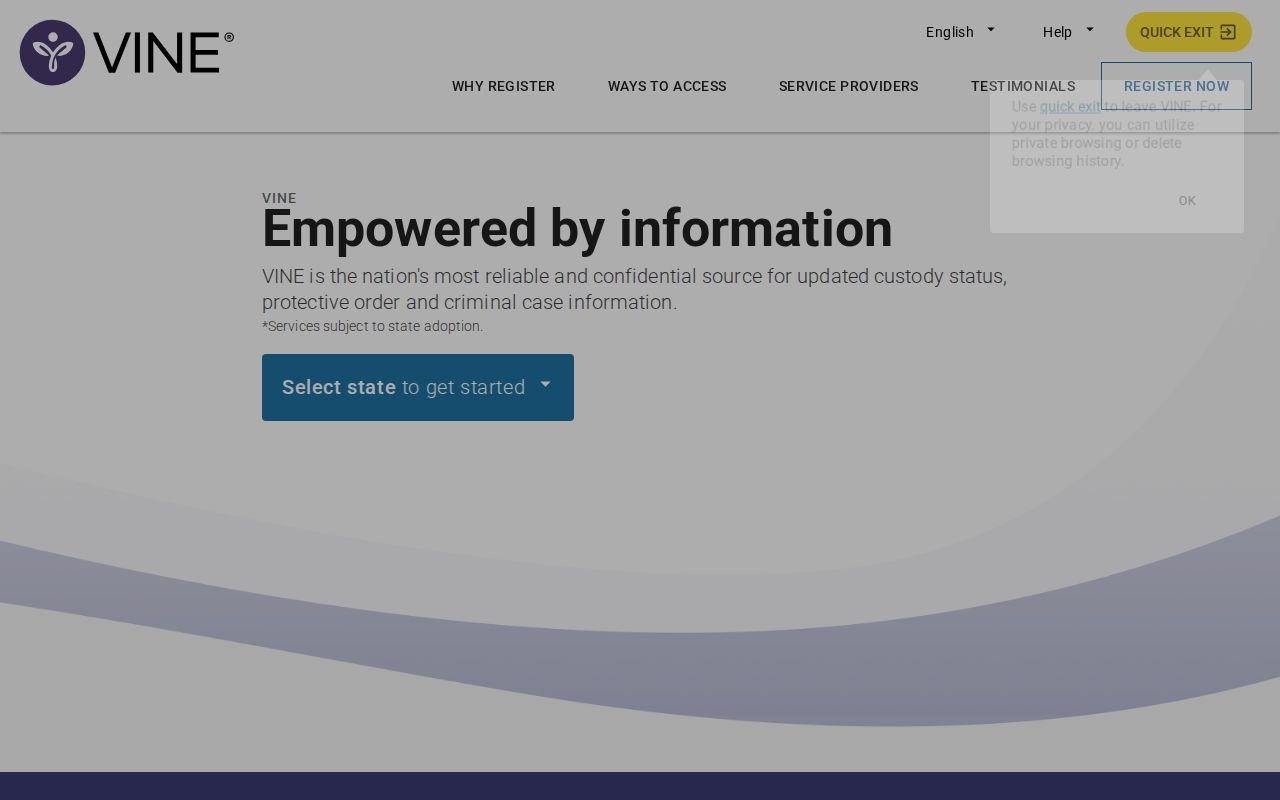
The assigned manifest image links to the live Texas selection and search interface.
Search a Lee County Inmate
A careful search reduces mistaken matches and missed results. Use the person’s official name and a known identifier when possible.
- Open the Texas VINELink interface.
- Select the custody or offender search offered by the current screen.
- Enter the surname and available first name. Add an offender or booking identifier when the interface permits it.
- Use age or birth details if shown. Do not choose among same-name results by name alone.
- Compare the reporting agency, identifier, age or birth information, and other visible facts.
- Open only the record that matches. Record the exact custody wording and last-update time.
- If no result appears, try a verified spelling or identifier, then contact the likely custodian rather than assuming release.
The Lee County released inmate search helps identify whether the case belongs to Lee County Jail, TDCJ, another county, BOP, ICE, or a court. That routing step is essential. Someone described as being “in Giddings” might have been held at Lee County Jail or at the Giddings State Juvenile Correctional Facility. The latter is a TJJD youth institution with confidentiality limits, not an adult VINELink lookup promise.
Lee County VINELink Result Fields
Fields vary with the reporting source. Do not assume that a field seen for one Texas agency will appear for Lee County or TDCJ. Read the current record as displayed.
| Visible item | How to read it |
|---|---|
| Reporting agency | Names the source whose custody status is being reported. |
| Custody status | May show a current state or an event such as Released or Out of Custody. |
| Offender or booking identifier | Helps distinguish people with similar names. |
| Facility or location | May identify the current source location; absence does not prove community release. |
| Last update | Shows when the displayed agency-fed information was refreshed, if provided. |
| Event and alert choices | Shows which custody changes and delivery methods are offered for that record. |
“Released” means the reporting source sent a release event. “Out of Custody” likewise means that source no longer reports custody. Neither phrase rules out transfer to another county, TDCJ, BOP, ICE, the U.S. Marshals Service, a hospital, or another authority. It also does not settle parole, probation, mandatory supervision, or a pending case.
A Lee County release record can show when the sheriff relinquished custody and may identify the authority or recipient. A court judgment or order explains the legal action. VINELink adds notice and a current agency-fed status, but it is not a certified copy of either record.
Register Lee County Release Alerts
Registration should begin only after a positive match. Options and labels can change by agency, so follow the controls on the live record rather than expecting one fixed screen.
- Open the correct matched person record.
- Select Register, Notify, Protect, or the equivalent control.
- Choose an offered event, such as release or custody change.
- Select an available channel. Phone and email are common; text and app choices vary.
- Enter the destination carefully and complete the on-screen validation.
- For an automated call, create the requested PIN, traditionally four digits. Enter it when the call arrives to acknowledge receipt and stop repeats.
- For email, use the validation message or account step shown. Do not assume email uses the telephone PIN.
- Save the reporting agency’s direct contact details for later confirmation.
Keep the PIN and destination private. They are subscription credentials, not public-record fields. If several relatives or support people need updates, each should follow the service’s current registration rules rather than sharing a private PIN.
An alert can arrive after the underlying event because source reporting and delivery take time. Never wait on VINE for an emergency. Use emergency services for immediate danger, and call the reporting agency for a time-sensitive custody question.
VINE Is Not Lee County’s Ledger
VINELink is event-driven. Lee County’s certified or durable historical release evidence comes from the agency that held the person, not the notification layer. A “Released” or “Out of Custody” event should trigger direct confirmation because it can coexist with transfer, another hold, supervision, or stale source data.
For Lee County Jail, check the sheriff’s released filter and call 979-542-2800. If more detail is needed, use the Sheriff Public Information channel and request the booking and release record. Mail goes to P.O. Box 98, Giddings, TX 78942; designated email goes to info@leecountysherifftx.org; fax is 979-542-1446. Keep the request narrow and identify a booking number or date range.
The sheriff’s released module was under maintenance during research and has no verified 24-hour or 72-hour window. The Jail Releases: 24 Hours and Jail Releases: 72 Hours pages explain how to check defined time ranges without mislabeling that unknown-window feed.
Confirm Lee County Custody Changes
Start with the reporting agency on the VINE result. If it names Lee County, compare the sheriff release record. A release timestamp proves the sheriff ended that booking’s custody. It does not prove freedom from all custody. Ask about the recorded release type and any receiving agency.
For an adult TDCJ case, the official online offender search covers currently incarcerated TDCJ inmates only. It is updated on working days and is at least 24 hours old. A no-result after release is therefore expected but ambiguous. Historical information must be sought through TDCJ’s email inquiry or Public Information Act process. A projected or scheduled date is not an actual release record, and even a parole approval can change before departure.
Federal cases require the Bureau of Prisons locator. VINELink should not be presented as BOP coverage. Possible immigration transfers require the ICE locator, whose no-result can reflect transfer, release, removal, recent processing, or data limits. Another county requires that county’s jail. A receiving system must be checked until the custody trail resolves.
Court records answer a separate question. Felony cases in Lee County use the District Clerk and district courts; county-level misdemeanor records use the County Clerk; Class C matters may use a justice court. A judgment, dismissal, bond order, or sentence can explain legal authority, though only the custodial agency establishes its processing time.
Released Versus Current VINELink Status
A current-custody result indicates that the named reporting source still shows the person held. A released event records a change from that source. A no-result records nothing conclusive. These three outcomes should never be treated as interchangeable.
The live Lee County booking view is also a current-status lead, not a way to find a past release. Disappearance can follow a true release, but it can also follow maintenance, lag, transfer, an alias, or the site’s aging rules. The sheriff’s separate released filter is the better local release source when operational. VINELink is useful when the aim is to watch a specific matched person for a future event.
Probation and parole are not custody statuses. Probation is court-ordered community supervision and may occur without a TDCJ prison term. Texas parole or mandatory supervision follows state imprisonment and is managed through the TDCJ Parole Division. A person can be out of a jail while still subject to supervision. The Probation & Parole page explains Lee County’s official routes.
Handle VINELink Mismatches Safely
When several records share a name, stop and compare identifiers. Do not infer identity from a name, photograph, or approximate age alone. If visible details conflict, contact the reporting agency with the record identifier and ask which public detail can clarify the match. VINELink is not an emergency service or a full criminal-case file.
If the reporting agency corrects or updates its source, VINELink may take time to reflect that change. Ask the source office about its correction process. For a Lee County booking error, identify the exact booking to the Sheriff Records Division. A court-record error belongs with the clerk that maintains the case. Each custodian can address only its own material.
Keep a simple verification log: search time, exact status text, last-update value, reporting agency, record identifier, alert time, and direct confirmation. This preserves the difference between what VINE reported and what the agency later confirmed. It also prevents a delayed notice from being mistaken for the exact moment of release.
Public Record Search
Sponsored Results