
Lee County Parole Versus Probation
Parole is conditional release from a TDCJ prison sentence. The Texas Board of Pardons and Paroles makes release decisions, and the TDCJ Parole Division manages supervision in the community. Mandatory supervision is another state-prison release form governed by statute and Board action in eligible cases. Probation, formally called community supervision in Texas, comes from a trial court. A judge can impose it instead of confinement or after a short jail term. Local Community Supervision and Corrections Department staff then administer the court's terms.
The source record identifies the right path. A TDCJ number, prison sentence, Board vote, or release certificate points toward parole. A county judgment that says community supervision points toward probation. A Lee County Jail release after bond is neither one by itself. Bond means custody ended while a case continues. It does not establish a parole or probation assignment.
| Point | Parole | Probation |
|---|---|---|
| Legal source | TDCJ sentence and Board release action | Trial-court judgment or order |
| Supervising body | TDCJ Parole Division | Local CSCD under court authority |
| Best proof | Board, Parole Division, or discharge record | Judgment, supervision order, or discharge order |
| Public name search | No verified statewide search for people in the community | No verified statewide Texas probation search |
- Parole
- Conditional community release from a prison sentence.
- Probation
- Court-ordered community supervision, often without a prison commitment.
- Discharge
- An official end to the supervision term.
- Absconder
- A person alleged to have stopped reporting or lost contact, which may lead to a warrant.
Verify Lee County Release Supervision
No official public name-based lookup was verified for Texans already living in the community on parole or mandatory supervision. The TDCJ inmate search cannot fill that gap because it includes current TDCJ prisoners only. A no-result there is ambiguous. It may mean release, a spelling or identifier issue, or that the person was never in TDCJ custody. Probationers may never appear in the state-prison system at all.
Use a record-led process. Keep parole, probation, bond release, and a transfer apart at each step. Sensitive reporting times and residence details need not be sought or shared to confirm the broad status.
- Read the sentencing judgment or release record. Identify whether it names TDCJ parole, mandatory supervision, or court-ordered community supervision.
- For parole, contact the TDCJ Parole Division or the district office tied to the approved residence. Provide a full name and TDCJ or SID number when known.
- For probation, contact the clerk of the sentencing court and the official local CSCD channel. Request the judgment, modification, revocation, or discharge order that answers the question.
- If a warrant or absconder claim is involved, verify it through the issuing court, law-enforcement agency, or Parole Division. Do not infer it from an absent web result.
- Ask for a discharge record when the issue is whether supervision ended. A projected end date is not the same as a signed discharge.
Note: A Lee County jail release time proves that booking ended, but it does not identify every later supervision duty.
Lee County Georgetown Parole Office
The official county assignment directory places Lee County in the Georgetown District Parole Office of Region IV. This is the best local starting point for a parole question, even though the office is not in Giddings. It is not proof that a named person reports there. An approved residence or later reassignment can place the case with another district office.
The Region IV directory provides the official address and phone. Call with the person's identifiers and a narrow status question. Staff may limit what they release under law or policy.
Georgetown District Parole Office, Region IV40121 Industrial Park Circle
Georgetown, TX 78626
Phone: 512-863-0756
Fax: 512-863-4574
The county assignment is especially useful when a release record says parole but does not list the active office. Start there, then follow any official referral. Do not treat an office address as a reporting instruction for someone else.
The assigned office can confirm the correct administrative route. Exact proof may still require a properly framed TDCJ information request or the case record. Those channels preserve the difference between a current supervision question and a request for historical discharge data.
Lee County Parole File Review
Texas ordinary parole consideration is an administrative file review, not a public courtroom-style hearing. The Board review process says Parole Division identifies a case before eligibility, an Institutional Parole Officer prepares a summary, and a three-member panel votes in sequence. Two matching votes make the decision final. A third member resolves a split. This matters because a supposed hearing date is not the right record to seek.
The Board uses decision codes. FI codes are favorable actions with different release or program conditions. RMS means release to mandatory supervision. NR sets a later review after denial, while SA can require service of the sentence balance subject to applicable law. DMS denies discretionary mandatory supervision and sets review. The official voting-options page is the decoder.
A favorable vote is conditional. It is not an actual gate time. TDCJ may still audit the file, approve a residence, require a program, resolve a detainer, and issue a release certificate. New information can also change the result. For the custody end itself, use the later release record rather than the vote alone.
The manifest image below comes from the official Texas parole review explanation.
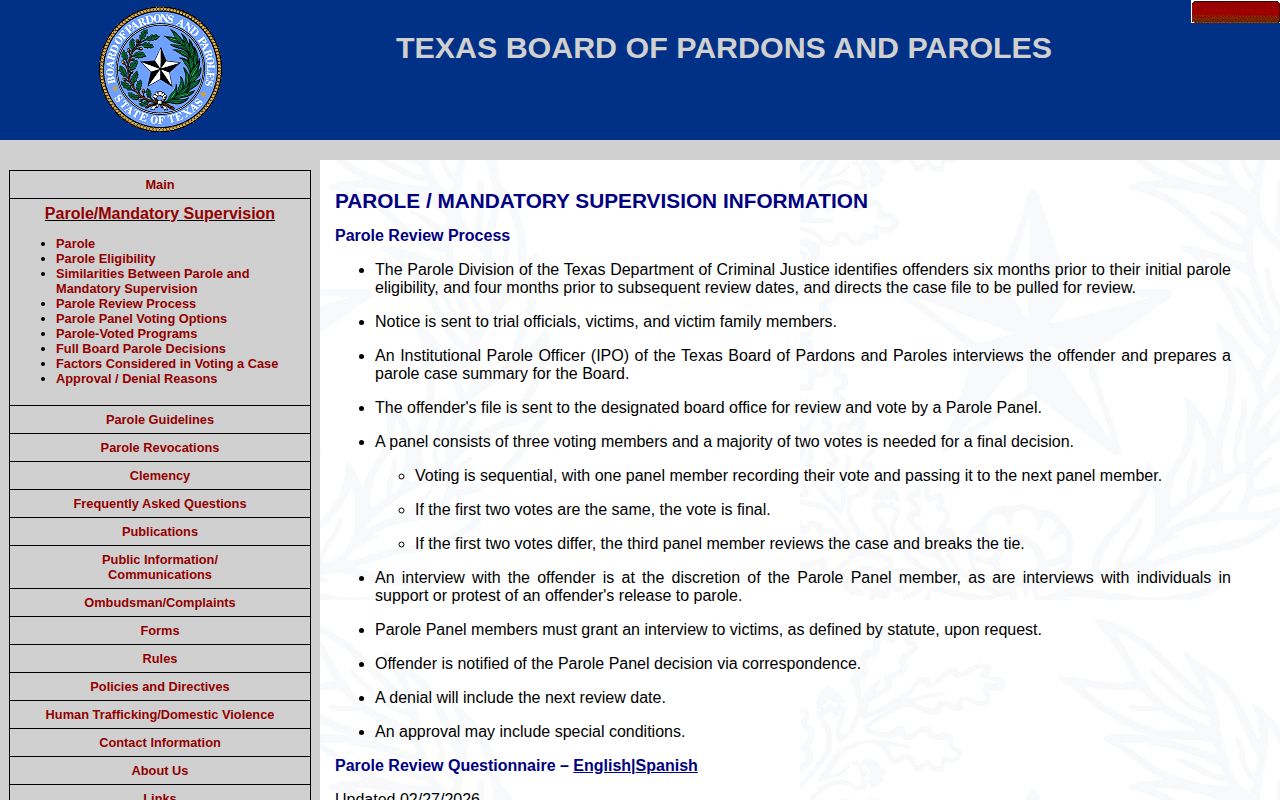
It shows why Lee County parole verification rests on file review and agency records, not an ordinary public hearing calendar.
Lee County Violations and Warrants
Conditions vary by order and case. They can govern reporting, travel, programs, fees, conduct, or contact. A violation allegation does not itself show the final result. The supervising agency may investigate, adjust conditions where authorized, or begin a revocation process. Revocation means a court or parole authority considers whether supervision should be withdrawn because of an alleged breach.
An absconder label generally means alleged loss of contact or failure to report. No Lee County-specific public parole or probation absconder list was verified. A person who vanishes from a jail roster is not therefore an absconder. Likewise, a missing TDCJ web result does not establish a warrant because that search omits released prisoners.
For probation, seek the filed motion, warrant, revocation order, or later discharge from the sentencing court. For parole, use the Parole Division and official warrant channels. A revocation hearing is distinct from the ordinary parole release review described above. It offers process after an alleged supervision violation; it does not create a public calendar for initial release votes.
Note: Confirm any warrant with its issuing authority before acting on a third-party claim or an old docket entry.
Correct Lee County Identity Errors
Name and birth-date matching can point to the wrong person. The Texas DPS registry provides a specific correction lesson that applies when checking a narrow, offense-limited registry record. DPS says an error should be reported to the verification agency shown in that record. It also warns that only fingerprints positively establish identity. A similar name, age, or address is not enough.
The DPS registry is not a general parole or probation list. It covers people with qualifying registration duties, and its address or verification details do not prove a Lee County jail release date. It also cannot correct a sheriff booking record. Direct a sheriff record error to the Lee County Sheriff's Office and a court order error to the clerk that keeps the case.
Keep the correction request exact. Identify the record, explain the field believed to be wrong, and provide reliable supporting material. Ask the owning agency to amend or annotate its own record. This avoids spreading a mismatch across unrelated systems and protects the distinction between registry status, parole status, and probation status.
End Lee County Supervision Records
Supervision ends through official action, not merely because an expected date arrives. A parole discharge comes through the state process. A probation discharge appears through the sentencing court and local supervision system. Early termination, revocation, a modification, and completion are different outcomes. The signed record controls.
Ask for the final discharge or termination document by name and case or offender number. If the person was first held at Lee County Jail, the sheriff release record proves only the end of that booking. The broader Lee County released-inmate search and records path explains how to reconcile the jail timestamp with the court and receiving agency.
A discharge from supervision does not itself erase the arrest, booking, conviction, or court file. Texas expunction under Code of Criminal Procedure Chapter 55A and nondisclosure under Government Code Chapter 411 are separate court remedies with their own terms. A missing online result cannot establish that either remedy was granted.